
Peter Senge
‘highlights the role of system leaders’ in fostering collective leadership to address complex challenges’ Senge et al. (2015)
Systems Terminology
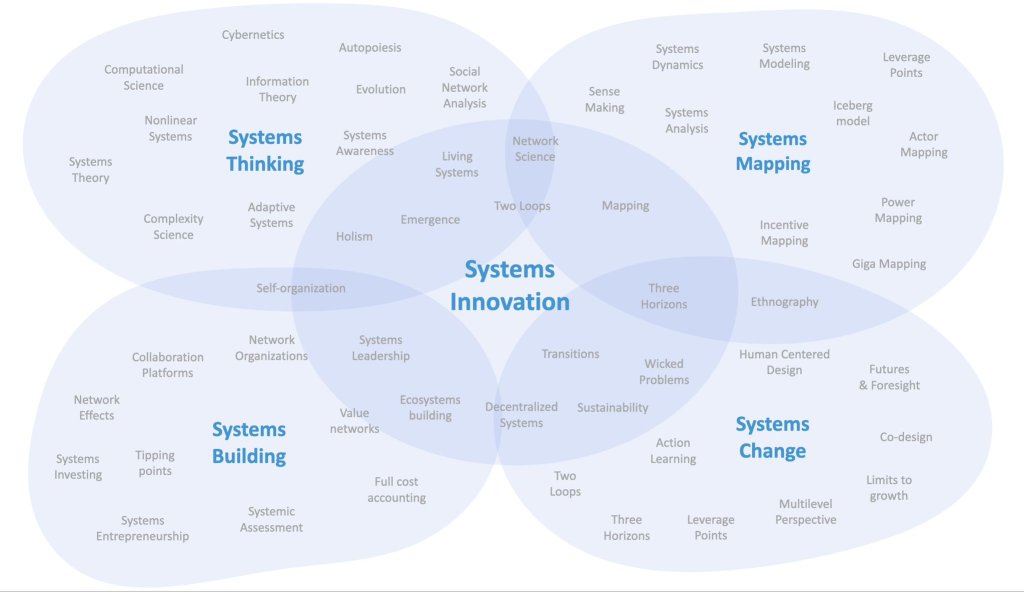
The cosmos of ideas and methods that form part of systems innovation for systems leadership are growing. On this page you will find a couple of the generic principles to help those leading in systems understand and then apply what may be most helpful to their work.
A System:
Simply put a system is bounded. It comprises of a set of elements or parts that are interconnected in such a way that they may produce their own, potentially unexpected, pattern of behaviour over time.
When dealing with complexity, it can be easier to jump to suggesting solutions to ill-defined problems without analysing the causes of these problems. Systems approaches shift the focus towards understanding issues and developing goals that fulfil multiple goals rather than one single goal. This enables solutions to emerge that address the causes of problems rather than treating the symptoms. Source Civil Service:
Systems thinking is a framework for seeing the interconnections in a system and a discipline for seeing and understanding challenges in the context of the whole system; the relevant ‘structures’ that underlie complex situations.
Systems Thinking
Systems thinking can seem difficult, but it doesn’t need to be. Introducing some systems thinking into your work is better than none. Systems thinking is applicable to all, regardless of prior knowledge, grade or profession. Systems thinking is clearly relevant to strategic work, but it is also valuable and applicable when work is more reactionary and fast-paced. It helps to create the conditions in which innovative ideas can emerge. This is vital at times of crisis, when the way forward isn’t always clear or obvious. Bringing in some key aspects of systems thinking into your work can be done quickly and still increase the effectiveness of your work, for example ten minutes developing a rough map of a system, or listing possible enablers and blockers to success, or identifying your key question for testing your intervention is performing, can all be very impactful. Likewise, systems thinking is relevant even if the goal/output for the project has already been set, for example to increase the number of apprentices by x amount or reduce the time taken for a passport application by x. Understanding how to achieve that goal through identifying key drivers of system behaviour and broader project dependencies and exploring how best to influence the system to set the conditions for success, are all parts of a systems thinking approach. Source Civil Service:
Systems Leadership
Systems leadership is about building a culture in which systems approaches can flourish.
Systems leaders set the tone for an organisation to work more systemically and encourages staff to embed systems approaches in their work.
A systems leader will:
Influence other leaders to shift the collective focus in the right direction and develop and maintain cross-departmental and cross-directorate relationships so there are shared understanding of goals and of the system.
Encourage the use of systems principles and tools for complex problems by promoting collaboration across traditional siloes, within or outside the team.
Think about the wider system and ask questions that explore the possible impact of certain actions on the wider system.
Ensure positive changes towards shared goals are sustained through monitoring and evaluating progress towards them.
Systems Leadership in practice
The optimium is a climate approach whereby we create the environment for innovation a learning culture where systems leaders can take up their agency to lead, no matter what their level. This relies on co-production and design, psychological safety and governance.
Systesm leaders must navigate complexity and foster collaboration across numberous organisational boundaries within thier own organisations and between others. System leaders adopt a ‘both/and’ mindset, focusing on framing problems rather than providing immediate solutions. They balance lateral agility with adherence to governance and processes. Enabled leadership is crucial to ensure our people take ownership, make decisions, and act at the point of greatest impact.
Public sector systems must ensure accountability, value for money and ensure their work and decisions are robust, holding up under scrutiny. Collective leadership involves more in the creation and development of plans and strategies. Distributed decision-making ensures leaders can make decisions as close the the impact as possible while ensuring appropriate oversight via our ICS leadership groups.
| An agile culture – where people are encouraged to develop ‘lateral agility’ with the ability to move from side to side while maintaining balance |
Systems Leadership
Systems leadership is relational, focusing on connections rather than centrally delivering programmatic objectives. Success cannot be measured by outputs alone but by the quality and quantity of interactions along with the outcomes they produce. At the heart of this is the creation of meaningful relationships in environments that foster agency. These connections, and the activities that arise from them, generate valuable data. Leadership conversations, guided by positional leaders, help make sense of complex challenges and direct attention to what truly matters, creating an organic, evolving focus. Senior leaders must be able to hold the dissonance to create both/and mindset to bring all along in understanding the paradoxes of multi-level leadership,
Achieving System Leadership
To achieve effective system leadership for transformation and healthy organisational functioning, there needs to be need groundswell of leaders from all parts of the system who prioritise the system first, promoting collaboration and empowering others.
Fostering a Mindset for Collaboration and Transformation
Good collaboration starts with listening and meeting people where they are at, not where we think they should be. We help organisaitons cultivate an organisational mindset that empowers leaders to drive change where it is most needed, enabling them to maximise their impact at the point of decision-making. Using system innovation tools such as an exemplar hubs, accelerated design events and whole system interventions such as coaching for leaders become key enabler for activating system transformation bolstered by underpinning mindset shifts. Here is an example of large event Innovation Challenge that got a job done (accelerated design) and applied theory into meaningful practice.
Psychological Safety
Learning Organisation: Top Watch:
I A blame culture will stop innovation dead. This does not mean we are not accountable, quite the opposite. We are eager to learn what could be better and how we can improve our approach. Where we have made mistakes we have so much to learn.
Leadership Development and System Thinking
‘Achieving the best outcomes from people requires exceptional leadership. True leadership is not about individuals who stand tall but about communities that lift others. It demands leadership at every level of the system, across diverse staff groups.’ Lord Ara Darzi of Denham, NHS Rapid Review 2024
The exmplar hub in its simplest form is soemthign to point at. In this asset based approach we find what you have and while showcasing it (and thereby sharin) we start there. We also may begin afresh and use the hub as a anchor to ensure oversight and evaluation during the early development and testing stage.
Leadership Role Transitions:
Executive leaders are now stepping into roles that resemble global leadership, requiring diplomacy, rapid decision-making, and the capacity to navigate both internal and external complexities. This impacts senior and middle managers and leaders. These leaders have a key role in helping leaders at all levels to ‘sense-make’ so they can lead in increasingly Volatile, Uncertain, Ambiguous, Complex terrain. (VUCA)
Mid to Senior Leaders must now operative with a both/and mindset as system framers not solution providers. This is a significant transition and is occurring globally but for our country and public services it is a significant move away from mechanistic output based working to outcomes. Crucially these outcomes can only be uncovered through co-design. There is a
Enabled Leaders Everywhere are the cornerstone to successful system leadership. Everyone, everywhere must enabled to make the best decisions at the point of most impact and be supported in the intended and unintended consequences. These are typically supported by junior to Mid -Leaders and Operational Managers who provide appropriate support within a hierarchical structure and autonomously to operate their role for our population current and future needs. They are best placed to know what our citizens needs and how to make that happen.
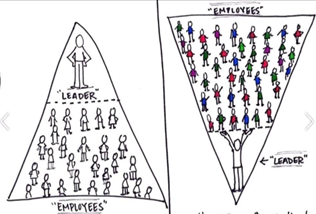
As orgnisational purposes are flipped and consumers and the value are at the top, which creates an inverted triangle. In order to achieve this we also need to flip our leadership triangle. No longer is the leader at the top but is a the bottom. They are servant leaders, enabling their workforce to lead rather than command and control from the top. This allows our leaders to make the most impact where it is needed, as it is needed – we call this enabled leadership. Apart from times of crisis, this is our approach and marks a significant shift.
Community of Practice – Cog in the wheel
We believe in gathering the right people in the room—those with subject matter expertise, clinical leadership, and the authority to collaboratively develop solutions. This approach fosters energy and generates diverse ideas.
Systems Leadership Community of Practice – are places for sense making together and are not hierarchical. Eveyone has an equal role. This does not mean they are not also their own role rather they have two hats but the system hat is priority.
Our Purpose:
- To build relationships beyond organisational boundaries.
- Help us all understand where we are as a system – celebrating success and sharing our challenges
- Utilise colleague expertise and skills to help each other and address these challenges, with the intent to improve citizens and colleague experience
- To aid professional development of participants
Why?
Our experience shows that dialogues offer opportunities to explore specific issues in discrete situations, helping to co-create meaningful narratives with shared direction. We call this a dialogic approach. These dialogues have the potential to develop transformation pathways, support transformation processes, and maintain functioning interfaces between different, sometimes competing, institutions, sectors, and disciplines. They also help coordinate collective responses to challenges, threats, and opportunities and are also exciting where real change happens in the room! (online or in person)
We encourage diversity of participation in these dialogues, aiming to widen the circles of engagement and enable everyone to contribute, regardless of differences in power, positions, or expertise. When you come to a community of practice for systems leadership you will arrive from your host organisation but taking a system first perspective and is lets We aim to foster dialogue where participants actively listen and explore synergies, as well as options for value-adding, collective action with those they may not typically engage with.
The group is an important commitment to supporting ICS leaders and innovation for transformation. We recommend that a senior leader from the attends each Community of Practice event who can also connect into our executive board. This will allow participants to ask questions and better understand Systems Leading within the context of our the whole system and the CoP (and so their part of it) time investment informing strategic decision making.
The sessions are straight forward with a simple structure and roles.
- Convenor, curator, facilitator from a small team of willing members from system. (This requires an adminitration lead to co-ordinator as a small group to keep the meetings flowing and engageed with regular communications and engagement)
- Curation and facilitation of each CoP (themes and assistance during the session) (This is like the chair and co-chair – we recommend an OD or Comms/Engagement lead to support a specialist or senior leader )
Outcome and measuring impact: Dialogic methods are challenging to track specific impact. We anticipate the CoP will naturally highlight strategic inputs and activities that are working well in they system which may help the whole system.This surfaces the most promising initiatives while also creating the leadership space and governance to develop new initiatives will enable our system to identify shifts and innovations surfaced by the dialogues with support in an Exemplar hub or similar for the most promising initiatives. Annual synthesis from these dialogue process will give some solid data and overall tracking of connections. These may include feedback from task and finish groups that emerge alongside or as a result of the CoP.
When:
Meeting regularly throughout the year helps when convening large numbers.
We say 10 meetings and no less than 6 including one-two face to face/In-person meeting .
It is a good idea to create a rhythm and ideally choose the same time monthly, perhaps alternate Fridays and Wednesdays gives options for more participation. Plan in a Summer and Winter (August and December which gives 10 (once per month less natural stops)
What will happen
1.5 hours online and 2.5 hours in person is a good length of time. The session should take time to begin with introductions and a briefing style for around 20 minutes on local context of national and global related issues. The floor is then opened for questions and comments using the the meeting chat function to gather themes (the team here are helpful) or in person on small tables. The moderator, ideally from OD and/or communications specialist will support the sessions.
How do I Join?
Ideally they are posted to one zoom link for ease of joining with a password access or waiting room.
One or our core objectives:
As system leaders, the common purpose is key. Simple and clear that all can get behind while getting on with the day job. What is the primary task which the system can uniquely solve.
Effective collaboration requires that all work from a shared purpose, finding common ground and focusing on what can be achieved. It takes longer to get to the point of actions, formerly seen in meeting where each took/was given a task for next meeting. The aim here is to improve the value proposition, and free up time by connecting the system together. This creates its own momentum and reduces duplication, releasese the benefit of shared assets, and aligns approaches.
To maintain our open culture keeps the system future ready, avoiding going backwards (the same as stopping). The joined up system can spring boarding from what works well in one part or needs to be created from fresh. As groups centre around a task this prevents siloed working while also preventing closed cultures from forming. All system leadership and talent initiatives then benefit from the joint energy and focus to power th whole system forwrad. Sector, partner, and specialist initiatives will also be recognised and known to avoid ‘re-inventing the wheel’ and reducing the need for expert consulting for elements we have in-system expertise.
External support and programmes will continue to shift from delivering set programmes to supporting a more adaptive approach that suits our system and partners objectives. Key initiatives will work for the entire system, powered by aligning system assets around them (e.g. Team/Group Coaching, Culture and leadership development programmes. As consultants we provide essential support, challenge, and expertise, helping address specific challenges as they arise.
The Community of Practice membership will continue to grow in ways that are progress the mission. Often this may be during typical events that are typically dialogic such annual meetings and design meetings. Other times a set session such as a whole system innovation challenge will stimulate collaborative progression.
Talent Progession for Systems Leaders
Systems must aim to retain, discover, release, support, and develop talent through robust infrastructure and leadership pathways. The aim is empowering all levels to be able to take up their agency and guide us towards better health outcomes.
Ambitions
| • Foundation of career conversations |
| • Focus on retain first then attract |
| Internal Talent Pipelines |
| •The system can connect talent. |
Our Identity:
The aim is to be able to see, and then know and then utilise system wide data and local know-how to inform strategic direction while getting on with the job. The adaptivity and oversight is designed into structure to ensure it is possible to adapt swiftly to emerging needs and insights identified. This may be something like an exemplar hub and other test and learn spaces as well as improvment huddles and a gradual learning culture where innovation is part of every day work. Small teams are cruical to come together and make rapid decisions with learning at early stages to ensure the right direction. Once tested (parallel) during a wider pilot phase to ensure it addresses both current and future leadership gaps it is developed further in replicable models. Some areas may need adapation for local partner fit but the core elements are agreed prior to spread and embed.
By strengthening internal connections across our system, we share our assets, reduce duplication and enhance collaboration, learning, and leadership development to ensure that future leaders grow together. Critically we retain our system talents and build a one team approach.
System Stretch for Optimisation
Working towards a learning culture takes time but we know that by leveraging the system spaces at the interconnection location we enable people to disentangle from their own organisations and be freed up. They share the best of what they did alone and couldn’t take forward either because it was not possible alone or their organsiational dynamics blocked progress.
This is a way of creating complex adaptive spaces (Uhl-Bien, 2020) which are similar to those experienced during Covid-19. A climate approach, where environments are conducive for innovation flourishing and leaders can act effectively. In turn this strengthens collaboration, learning, and understanding. The shared system needs to speak the same language to aid understanding to build and then progress together. As AI (Artificial Intelligence) and tech continues to improves, people can better scope what is available and align with their own aspirations and focus on less process and more human relations.
Fostering a curious mindset for Collaboration and Transformation
Good collaboration starts with listening and meeting people where they are at, not where we think they should be. We aim to cultivate an organisational mindset that empowers leaders to drive change where it is most needed, enabling them to maximise their impact at the point of decision-making.
Systems Leadership
Systems leadership is relational, focusing on connections rather than centrally delivering programmatic objectives. Success cannot be measured by outputs alone but by the quality and quantity of interactions along with the outcomes they produce. At the heart of this is the creation of meaningful relationships in environments that foster agency. These connections, and the activities that arise from them, generate valuable data. Leadership conversations, guided by positional leaders, help make sense of complex challenges and direct attention to what truly matters, creating an organic, evolving focus. Our senior leaders must hold the dissonance to create both/and mindset to bring all along in understanding the paradoxes of multi-level leadership,
Achieving System Leadership
To achieve effective system leadership, we need a groundswell of leaders from all parts of our system who prioritise the system first, promoting collaboration and empowering others.
Broad Assumptions on Data
When ther eis limited data available key assumpations must be made with close evaluation. If there is data or most promising signs then they are utilised earlier for direction of travel.
To ensure decisions are grounded in the most relevant and comprehensive information available we recommend the following baseline:
- Local, Regional, and National Data
- Evidence-Based Research: Prioritise data that is supported by rigorous research, using proven methodologies to inform actions, experimentation and strategies.
- Anecdotal Evidence and Sample Evaluations: Finally, we incorporate anecdotal insights and conduct sample evaluations to provide additional context and refine our understanding, ensuring that our approach is both thorough and adaptable.
High System Potential
Identify any high system potential. Follow it everywhere to understand why if flourished. Use all the simple principles of Myron’s Maxims
Celebrating Diversity
Diversity is the systems biggest asset, so playing lip service to this will hinder progrewss. Now is the time to celebrate diversity in all the workforce. Aim to check at all stages if you are inclusive and fair in a way that is equal and works for all.
Commitments
Working in such broad ways requires genuine commitments.
Adopt Core Principles of practice and collaborative working to get started as principles of practice for collaborative working to set the foundations so that any task/initiative that lands can accellerate.
- Develop leaders whose capabilities align with system priorities
- Ensure all staff levels benefit from talent and leadership interventions
- Address under-representation through targeted initiatives
- Prioritise opportunities for staff from under-represented groups for accelerated development
- Drive forward actions that support inclusion and address inequality
Partner Responsibilities
While the small agile teams are accountable it is imporatn that the boards support this and hold accountability reviews locally and that are brough to the centre.
Agree a Shared Approach but not restricting to lists and tasks.
Determine Rules of engagement Principles
- Asset based approach – Springboarding from What works and learn from what doesn’t.
- System alignment with data, diagnostics, and measurement
- Leadership development and talent offerings that support diversity
- Annual refresh and review of tools used to help decision making in groups and priority setting ie: Priority Circle
Agree an adaptable approach in context of current data trends/pressures
- What areas are flexible and what cannot be adapated and must be statutory to ensure organisational safety.
- Consider financial challenges
- Agile but cohesive decision making: System partners can align different focuses under overarching system goals with our priority circle focus areas agreed annually.
Benefits Anticipated – 1,3, 8 years
Mindset shifts take 8 years to be truly embedded in culture. Yearly planning and rapid testing phases should be in one year review cycles. Many initiatives will continue to mature and spread to embed stage at year 3 while others will be over 5 years. To work in this way, and prevent retracting back to simple process led mechanistic fuctioning the following can help: The consultants work this through with key stakeholders together.
- Leaders everywhere capable of navigating complexity and making decisions close to the source of issues
- A shared understanding of talent management with system-wide principles
- More reliable known risks from data and predictions.
- Oversight of System risks related to transition stages and support perceptions.
- Improved risk sharing of innovative opportunities
- A diverse, ready-now pipeline of leaders and specialists
- Leveraging diversity to foster a learning culture across the system
- Improved risk management, data-driven insights, and mitigation strategies
- Enhanced understanding of staff mobility and retention challenges within the system
Governance
Supported by the Board all strategies will endorse and empower leaders to implement effective local solutions aligned with system-wide goals. Collaboration will be prioritised to reduce duplication, share resources, and align partner ambitions. In all our efforts the system works together led by the board, informed by the system.
 System Synergy